
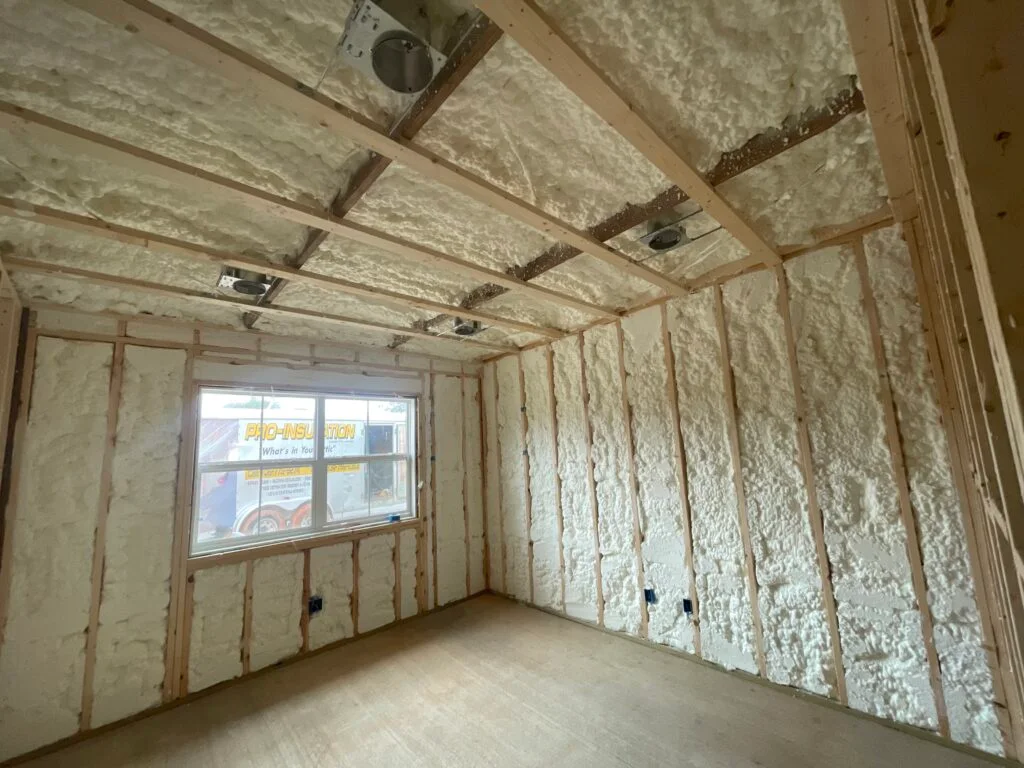
Which foam is the better choice?
Neither is the automatic winner for every Auburn or Opelika home. Open-cell foam is generally lighter and more vapor-permeable. Closed-cell foam is denser, usually provides more insulation value per inch, and can provide vapor control at a product's tested thickness. Both can provide air control when the specified product is installed correctly.
The useful question is not just "Which foam is better?" It is "Why does this foam suit these surfaces in this building?" Ask the contractor to explain that recommendation before comparing the totals. Our spray foam insulation service page introduces the applications; this guide focuses on the decision between the two types.
Open-cell vs. closed-cell spray foam at a glance
| What to compare | Open-cell foam | Closed-cell foam |
|---|---|---|
| Structure | Lower-density, softer foam with a more open cell structure. | Denser, more rigid foam with a predominantly closed cell structure. |
| R-value and space | Typically needs more depth to reach the same R-value. | Typically provides more R-value per inch where available depth is limited. |
| Water vapor | More vapor-permeable; not a substitute for a vapor-control layer where one is required. | Can act as a vapor retarder at a product-specific thickness. Check the published performance. |
| Air leakage | Can provide air control at the product's tested thickness and with continuous coverage. | Can provide air control at the product's tested thickness and with continuous coverage. |
| Budget | Often has a lower material cost, but required depth and related work affect the total. | Often has a higher material cost. Compare the completed scope, not equal inches alone. |
The Spray Polyurethane Foam Alliance's comparison explains the material categories. Manufacturer Johns Manville also discusses thickness and cost tradeoffs. Those general descriptions do not identify the product being quoted for your home or establish its required depth.
Is closed-cell always better for Alabama humidity?
No. Slowing water-vapor movement is different from controlling indoor humidity or fixing a leak. A lower-permeance material is not automatically the right answer everywhere; the roof or wall also needs an appropriate way to handle moisture and dry.
For a roofline project, discuss the roof covering, sheathing condition, existing ventilation, indoor moisture, and the plan for the attic after the work. DOE/PNNL guidance on unvented spray-foam attics addresses both foam types and the need for moisture removal. Foam selection alone does not provide that plan.
What changes when insulating an existing attic?
First establish whether the proposal keeps insulation at the attic floor or moves it to the roofline. Those are different projects. A recommendation to spray the roof deck should explain how the attic will be brought within the building's insulated boundary and how ventilation and moisture will be handled.
Roof leaks and damaged materials need attention before they are covered. Existing HVAC equipment and any combustion appliances also need assessment when changing the attic arrangement. The DOE/PNNL existing-roof retrofit guide explains why a conversion involves more than spraying a different material.
If a conventional vented attic needs more insulation, air sealing followed by suitable blown-in attic insulation may be a practical alternative. ENERGY STAR's attic guidance starts with air sealing and checking existing insulation. Ask why a roofline conversion would be preferable for your particular building.
For a local starting point, see attic insulation in Auburn or compare insulation approaches.
What about crawl spaces, rim joists, and metal buildings?
Do not carry an attic recommendation into every other space without checking the conditions. For a crawl space, ask how ground moisture, drainage, existing materials, and the intended enclosure affect the work. The foam choice should fit that plan, not replace it. Read about crawl space insulation in Opelika and rim joist insulation before comparing proposals.
For a shop or metal building, include its intended use, whether it will be heated or cooled, the surfaces included, and any manufacturer requirements in the discussion. Our metal building insulation page offers a starting point. A photo or a material name cannot establish the correct assembly on its own.
Compare the specification, not the appearance
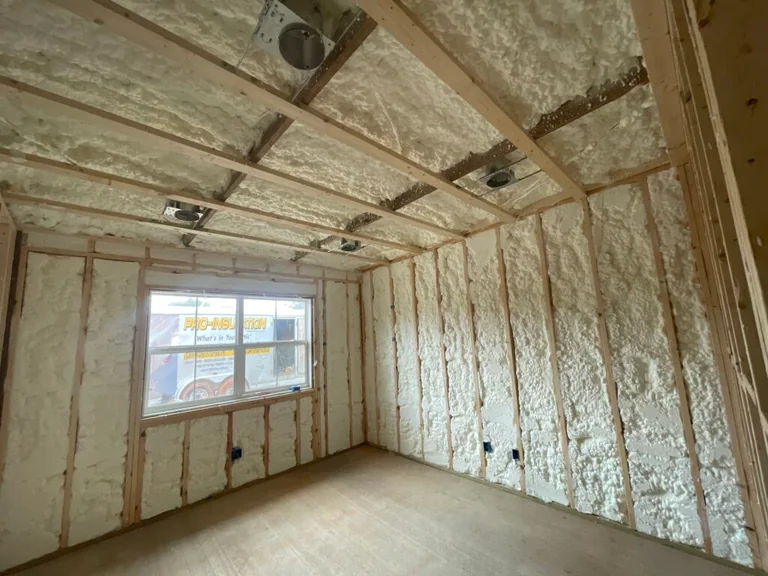
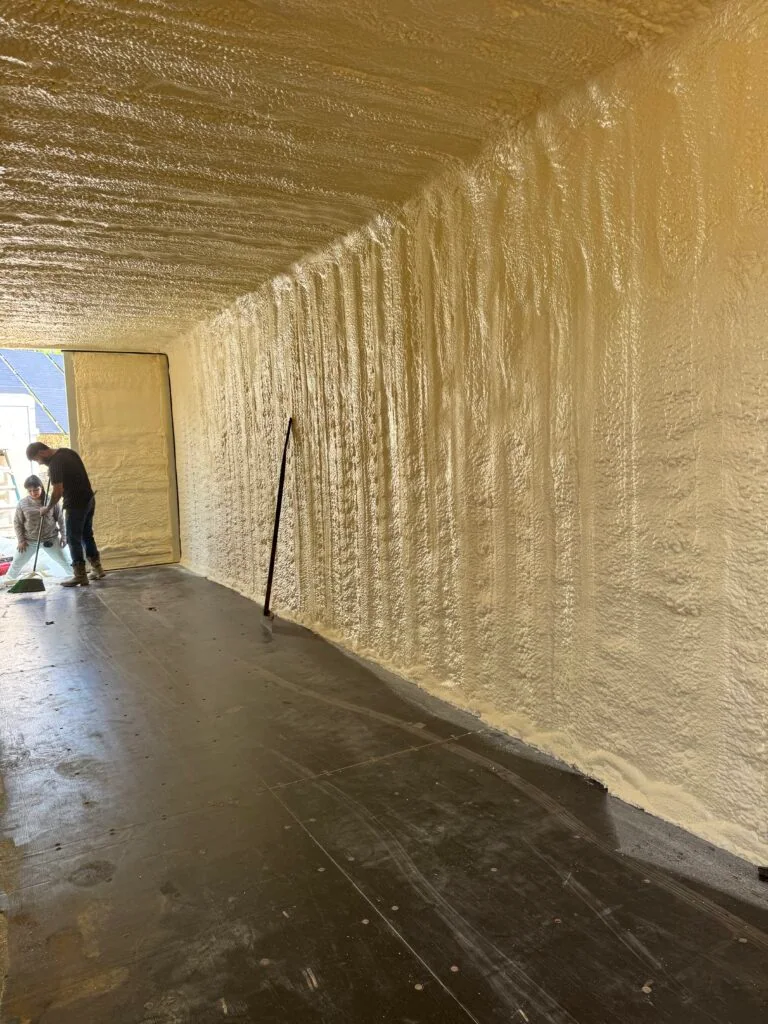
These photos illustrate coverage. They are not before-and-after comparisons or documented Auburn or Opelika project results.
Which costs less: open-cell or closed-cell?
Open-cell often costs less as a material, but that is not the same as being the lower-cost solution for every assembly. Equal surface area at equal thickness is not necessarily an equal-performance comparison. Ask which depth, R-value, preparation, coatings, and related work each estimate includes.
The Auburn and Opelika spray foam cost guide explains board feet and the measurements to compare. It uses clearly labeled illustrative calculations, not published Pro Insulations rates. A price for your building needs an assessment and a written scope.
What should the contractor put in writing?
- The manufacturer and exact product, not only "open-cell" or "closed-cell."
- The surfaces included, their measurements, installed thickness, and intended R-value.
- The air-control and moisture-control approach, including how the proposed assembly can dry.
- Removal, masking, disposal, cleanup, and any work excluded from the price.
- Any required protective barriers and the product-specific ventilation and re-entry instructions.
- The full price, schedule, payment terms, and any applicable written warranty.
If two contractors recommend different approaches, ask each to explain the reason in plain language. Keep the product information with your estimate so you can compare what is actually included. Our project-planning guide covers the conversation from inquiry through installation and follow-up.
Plan installation and re-entry before the work starts
Neither foam type should be treated as a simple occupied-room upgrade. Ask about property access, work-area preparation, ventilation, cleanup, and arrangements for occupants before agreeing to the schedule.
EPA's archived re-entry guidance explains that the product and installation conditions affect the waiting period. Obtain instructions for the specified product; do not assume one universal re-entry time for every job.
Discuss your Auburn or Opelika project
Pro Insulations serves Auburn, Opelika, and nearby East Alabama and West Georgia communities from Valley, Alabama. Tell us the space involved, whether it is new construction or an existing building, and the problem you want to solve.
Open-cell and closed-cell spray foam questions
Is open-cell or closed-cell spray foam better for an Auburn or Opelika attic?
Neither is automatically better. The roof or attic-floor assembly, available depth, moisture plan, product specification, and existing building conditions determine the recommendation. Ask the contractor to explain why the selected foam fits your attic.
Does closed-cell spray foam stop humidity?
Closed-cell foam can limit water-vapor movement at a product-specific thickness, but it is not a dehumidifier or a repair for leaks. Humidity management and the assembly's drying needs still require a plan.
Does open-cell spray foam provide an air barrier?
It can, at the selected product's tested thickness and with continuous, correctly installed coverage. Being more vapor-permeable does not mean the foam cannot provide air control. Ask for the manufacturer's documentation.
Does closed-cell foam always have a higher R-value per inch?
Closed-cell foam generally has a higher R-value per inch than open-cell foam. Compare the exact products and their published R-values at the proposed installed thickness, rather than treating a general range as a project specification.
Will spray foam repair a leaking roof or prevent every moisture problem?
No. Roof leaks, drainage problems, and damaged materials need assessment before they are covered. Either foam type needs to be part of a suitable air, thermal, and moisture-control assembly.
Is closed-cell spray foam more expensive than open-cell?
Closed-cell often has a higher material cost, but the total depends on product, depth, surfaces, preparation, barriers, and related work. Compare written scopes and the intended performance; this guide does not publish company prices.
How long must occupants stay out after spray foam installation?
Follow the specified product's instructions and the contractor's site-specific ventilation, cleanup, and re-entry plan. Do not assume a single waiting period applies to every open-cell or closed-cell installation.
Can I request a free estimate for spray foam in Auburn or Opelika?
Yes. Contact Pro Insulations at (256) 790-9771 or use the free estimate page. Include the property location and the space you want assessed. An inquiry does not book an appointment or authorize work.
Related insulation guides
Sources and further reading
- SPFA: Open-cell and closed-cell material differences
- Johns Manville: Foam types, thickness, and material cost
- DOE/PNNL: Unvented conditioned attic assemblies
- DOE/PNNL: Existing-roof retrofit considerations
- ENERGY STAR: Checking and adding attic insulation
- EPA archive: Product-specific re-entry considerations
These resources explain general principles, not a specification or quote for your property. Manufacturer references do not imply that Pro Insulations uses or endorses a particular brand. Current product instructions and applicable local requirements must be checked for the actual work.